
How a platinum surface helps flip magnetic bits without an external field
By redesigning platinum’s atomic interface, researchers generated the spin orientation needed to write magnetic bits without an auxiliary magnet. The mechanism is promising but still experimental.
A magnetic-memory bit can be pictured, with some simplification, as a tiny compass. Two stable directions of magnetization—the collective ordering of atomic magnetic moments—represent 0 and 1. In magnetoresistive random-access memory, or MRAM, writing data means reversing that direction. Magnetization perpendicular to the chip surface, pointing up or down, supports dense packing of bits and stable data retention.
Spintronics seeks to perform that reversal using not only electric charge but also electron spin. Spin is an intrinsic quantum property associated with angular momentum; it does not mean that an electron is literally a rotating ball. An electric current transports charge. A spin current transports a collective spin orientation and can transfer angular momentum to a magnetic layer, exerting a torque that changes its magnetization.
The technological goal is to generate an electrical torque that reliably determines whether a bit ends up pointing up or down. An external magnetic field can help select the direction, but producing and controlling separate fields around billions of nanoscale elements would complicate a circuit. Deterministic field-free switching is therefore an important target for fast, nonvolatile, potentially energy-efficient magnetic memory.
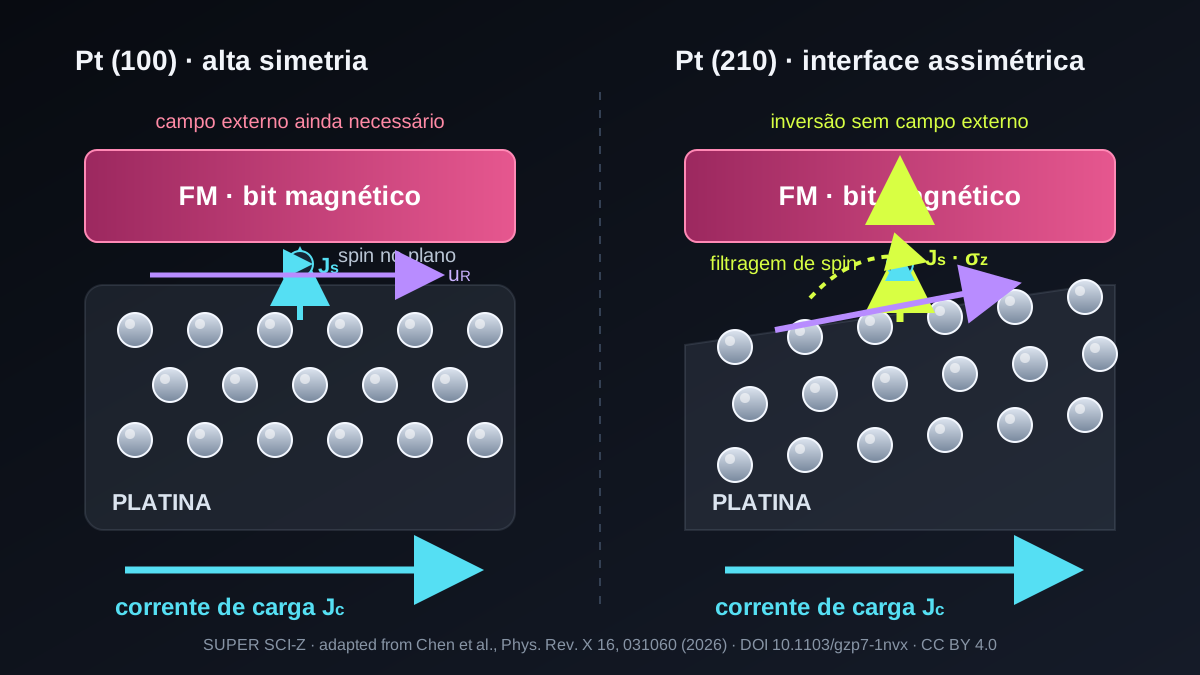
Platinum is useful because it has strong spin–orbit coupling: electron motion through the material interacts with spin orientation. Through the spin Hall effect, a charge current along platinum can produce a transverse spin current. Two directions must be kept separate: the direction in which the spin current travels and the direction in which the carried spins point—the spin polarization. In ordinary platinum, high crystal symmetry cancels certain components. What remains is mainly an in-plane polarization, which by itself cannot deterministically reverse a magnet whose magnetization is perpendicular.
Hongliang Chen, Zi-An Wang, and colleagues did not replace platinum with an exotic material. They changed how its crystal surface terminates. They fabricated epitaxial films—thin layers whose atoms grow in an ordered alignment with the underlying crystal. The notation (n10), with n from 2 to 4, refers to the crystallographic orientations (210), (310), and (410), different planes along which the crystal is exposed. These high-index surfaces have fewer symmetry operations than conventional (010) or (100) terminations.
At the asymmetric interface, an effective Rashba–Edelstein field emerges from the relationship between electron motion and spin when inversion symmetry is broken at a surface. This is not a physical sieve with holes. It is a quantum selection mechanism: transmission is most likely for electrons whose spins align with the local field, decreases for oblique orientations, and is strongly suppressed near the opposite direction. Because it handles angles beyond simply parallel and antiparallel, the process is called noncollinear spin–orbit filtering.
This selection prevents all tilted spin components from cancelling as they normally would in highly symmetric bulk platinum. At the (210), (310), and (410) surfaces, which have C₁ᵥ symmetry—essentially one relevant mirror plane—the interfacial field can tilt and preserve a z-polarized component perpendicular to the chip. Field-free switching appeared in all three low-symmetry samples but not in the higher-symmetry (010) and (110) controls. A control sample without platinum also showed no switching.
The team placed a stack containing titanium, ferromagnetic CoFeB, magnesium oxide, and tantalum on the platinum and patterned five-micrometre Hall devices. Electrical pulses reversed magnetization without an external field; in a circular geometry, the observed switching exceeded 98%. Electrical and magnetic measurements, interface microscopy, and first-principles calculations supported the interpretation that the asymmetric surface produced the required tilted spin polarization.
The out-of-plane spin Hall conductivity reached 0.75 × 10⁵ (ℏ/2e) Ω⁻¹ m⁻¹. This quantity measures how strongly an electric field generates the useful spin current, and the authors report it as a record among previous approaches to this polarization. The result demonstrates a physical mechanism and an experimental component, not a finished commercial memory. Energy per full-circuit write, endurance, thermal stability, manufacturing yield, and industrial-scale integration still need to be established. The central advance is that a familiar metal’s surface can bypass a constraint imposed by the symmetry of its bulk.
Editorial update — September 4, 2026: this article was rewritten to explain the spintronics concepts, distinguish current direction from spin polarization, and present the experiment’s method and limits more clearly. The reported scientific results remain unchanged.
Key points
- Spin is a quantum property; a spin current transfers angular momentum and can reverse a magnetic bit.
- Low-symmetry platinum surfaces prevented the cancellation of the perpendicular spin polarization needed for switching.
- The experiment achieved record conductivity and field-free switching but did not yet demonstrate a complete commercial memory.
Comments
No comments have been published yet.
Sign in with a subscription to comment.