
A single event brings LZ face to face with dark matter
Across a 2.84 tonne-year exposure, the experiment recorded a 248-kiloelectronvolt nuclear recoil where expected background is low. A global significance of 2.6 sigma makes the signal intriguing, not a discovery.
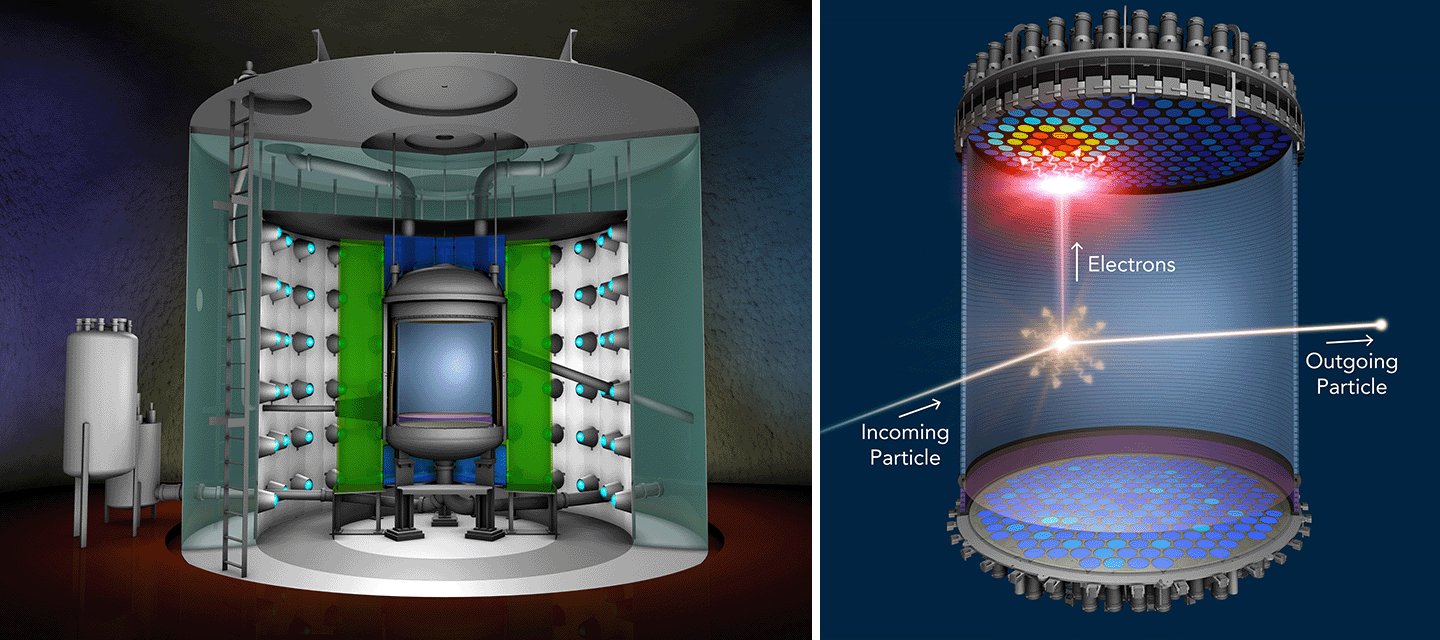
A flash in liquid xenon has placed one lonely number at the center of the dark-matter search. The LUX-ZEPLIN (LZ) collaboration found an event consistent with a xenon nucleus recoiling after receiving 248 kiloelectronvolts of energy, with statistical and systematic uncertainties of 23 kiloelectronvolts each. The detector operates about 1.5 kilometers underground at the Sanford Underground Research Facility in the United States, shielded from much of the cosmic-ray background.
The analysis covered 220 live days collected between March 2023 and April 2024, equivalent to an exposure of 2.84 tonne-years. Instead of merely repeating a conventional search for weakly interacting massive particles, or WIMPs, the team extended the nuclear-recoil window to about 270 kiloelectronvolts. That range probes effective-interaction and inelastic-dark-matter models capable of depositing more energy in xenon.
After modeling rare backgrounds and detector effects, the researchers found 2.6-sigma tension with the background-only hypothesis once the search across several models and energies was taken into account. The maximum local significance was 3.4 sigma. Under the adopted background model, the global figure corresponds to roughly a 0.5% probability of producing a discrepancy at least this strong; it does not mean there is a 99.5% probability that the event is dark matter. Particle physics conventionally requires 5 sigma for a discovery claim.
If a WIMP caused the recoil, favored models require a mass of at least 200 gigaelectronvolts per c²—more than 200 times the proton’s mass—and an interaction beyond the simplest elastic scenario. The paper is a preprint submitted to Physical Review Letters and has not completed journal review. One event also cannot reveal whether an unknown background source remains. More data will decide the direction: additional events with compatible energy and position distributions would raise significance; none would turn the flash into a fluctuation or a clue for revising the detector and its background model.
Key points
- LZ observed a 248 ± 23 ± 23 kiloelectronvolt nuclear recoil.
- The analysis used 220 live days and a 2.84 tonne-year exposure.
- Global significance is 2.6 sigma, below the 5-sigma discovery threshold.
Comments
No comments have been published yet.
Sign in with a subscription to comment.