
Roman’s Camera Records Its First Photons During Commissioning
All 18 detectors and the mechanisms in the wide-field instrument responded in space. The still-unfocused image provides the baseline for alignment, focusing and calibration before scientific observations begin.
Leitura autorizada · 3 crédito(s) restante(s)
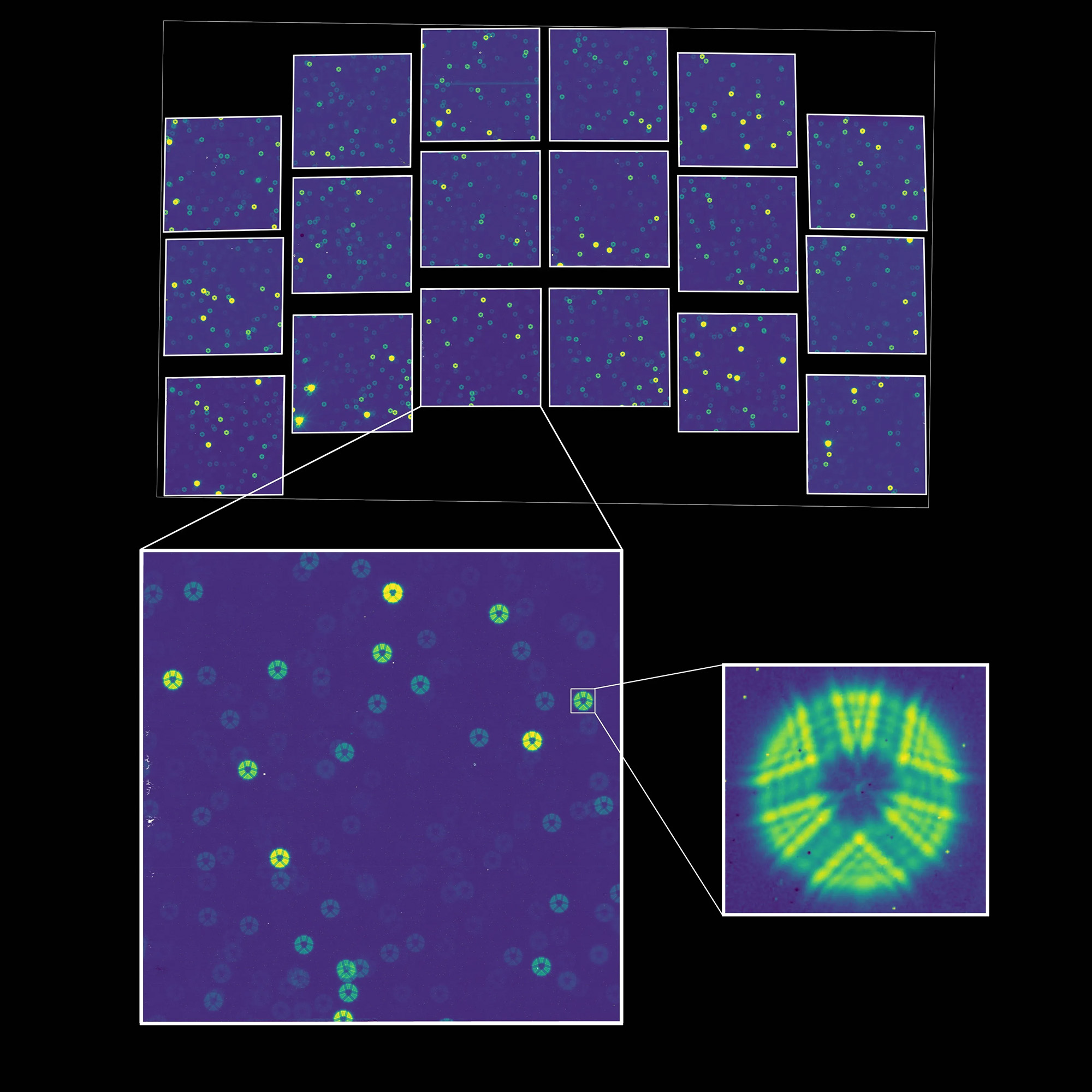
The Nancy Grace Roman Space Telescope’s main camera recorded its first photons of starlight during tests conducted from September 11 to 13. In the engineering image released by the U.S. National Aeronautics and Space Administration, NASA, stars appear as green rings spread across thousands of pixels. The result was expected: the detector array remained in the protected position used for launch, and the optics had not yet been aligned or focused.
The image confirms that light reached the Wide Field Instrument, or WFI. Separate checks confirmed that all 18 infrared detectors, the internal calibration system, the filter and prism wheel, and the focusing mechanism responded to commands and transmitted data to Earth. NASA’s official update, written by Ashley Balzer, distinguishes this initial record from a scientific image: it serves as a reference for concentrating the diffuse rings into sharp points.
Before switching on the detectors, the team kept the Wide Field Instrument warm for 10 days to remove moisture and chemical traces accumulated during preparation and launch. On September 11, the heaters were turned off and the assembly was cooled to approximately −143 °C, allowing the detectors to be activated. Over the next two days, engineers sent calibration signals, moved the optical elements without Earth’s gravity and checked the mechanical focus adjustment. The detectors then continued cooling toward their operating temperature of about −183 °C.
The Coronagraph Instrument underwent a different check. Ground operators established communication with its software, cameras, thermal control, mechanisms and electronics. The instrument combines masks with mirrors that can change shape slightly to suppress a star’s glare and test technologies for directly imaging giant planets and dust disks. After responding to commands, the coronagraph entered a period of decontamination and calibration; its optical performance has yet to be measured.
This work is part of commissioning, the phase in which a functioning spacecraft is turned into a calibrated observatory. Roman launched on August 30 and is traveling toward the region around the second Lagrange point, or L2, approximately 1.6 million kilometers from Earth. The orbital geometry of the Sun and Earth will allow the observatory to keep pace with Earth while following a broad path around that region, known as a halo orbit, with periodic trajectory corrections. Insertion into that orbit is expected in early December.
The scientific context comes down to a difference in scale. With a 2.4-meter mirror, Roman will deliver sharpness comparable to Hubble’s, but the Wide Field Instrument will cover an area larger than the full Moon in a single view. That panoramic field was designed for surveys of galaxies, stars, cosmic explosions and exoplanets. Dark matter, dark energy and planetary populations remain future research goals: the current out-of-focus image verifies one stage of instrument operation, not the final performance of those investigations.
Confirmed schedule: launch on August 30; activation of all 18 detectors, Wide Field Instrument tests and the recording of the first photons from September 11 to 13; release of the engineering image on September 15. In progress: activation of fine guidance, alignment, focusing, thermal stabilization and calibration. Planned: entry into a halo orbit around L2 in early December and the first scientific images in early 2027, provided commissioning proceeds as planned.
Live Science space and physics editor Brandon Specktor noted that the mosaic combines the response of all 18 detectors. The next measurable milestone will be to reduce each stellar ring to a point, keep the target stable using fine guidance and demonstrate that the instruments maintain focus and calibration during observations. Only then will the first light recorded by the Wide Field Instrument give way to the sweeping maps of the sky for which Roman was built.
Key points
- The engineering image confirms that light reached the Wide Field Instrument; separate tests validated its detectors and mechanisms.
- Focusing, alignment, fine guidance, stability and calibration still need to be completed.
- Arrival in the halo orbit is expected in December, with the first scientific images planned for early 2027.
Comments
No comments have been published yet.
Sign in with a subscription to comment.