
An Unexpected Martian Rock Records Three Episodes of Water
At the edge of Jezero’s ancient lake, Perseverance found rock formed from magma. Its fractures record three stages of alteration by water, expanding the search for preserved ancient environments beyond the lake’s sediments.
Leitura autorizada · 3 crédito(s) restante(s)
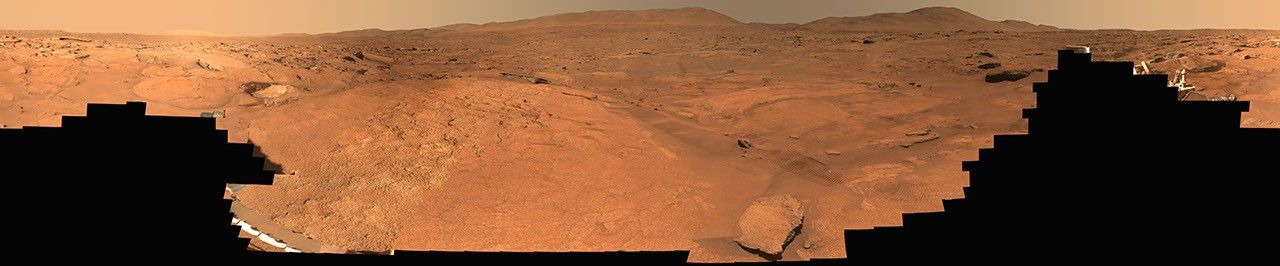
This discovery changes where scientists can look for the history of habitable conditions on Mars. In the Margin unit—a geological band along the inner rim of Jezero Crater—the Perseverance rover found igneous rock, formed as magma cooled, where researchers had expected layered sediments deposited by water. The finding shows that the ancient lakeshore preserves not only surface deposits but also a record of subsurface processes inside fractures in the rock.
The first clue came from the rock’s texture. At higher points along the traverse, coarse grains and crystals of olivine—a magnesium- and iron-rich mineral that reacts with water—indicate that magma cooled slowly underground. Alteration, meaning chemical and mineral changes caused by passing fluids, was limited there; at lower elevations, fractures, ridges and veins recorded a succession of transformations.
To place that history in order, the team analyzed more than 185 targets across an elevation change of approximately 265 meters. SuperCam, an instrument mounted on Perseverance’s mast, fires a laser at targets up to 6.5 meters away; each pulse vaporizes a tiny amount of the surface, and the emitted light reveals which elements are present. Composition, texture, elevation and cross-cutting relationships among veins provided the observations the researchers used to reconstruct the sequence of events.
According to the team, the first episode began when carbon dioxide-rich groundwater moved through cracks. Neutral or alkaline, the water reacted with olivine and formed carbonates, minerals produced in certain reactions among water, carbon and rock that record an environment’s chemical conditions. Because these mineral fillings resisted erosion better than the surrounding material, some now appear as small ridges.
A lower-pH solution—meaning one lower on the scale used to measure acidity and alkalinity—later circulated through the same fractures and rocks. In the study’s reconstruction, it dissolved and transported some of the carbonate, opened pores and promoted the deposition of silica, a material made of silicon and oxygen that can fill spaces in rock. The water may have come from the ancient lake or from cooler subsurface circulation; the data leave both origins as possibilities.
A third episode left its mark in younger fractures. Water heated underground—the concrete meaning of hydrothermal circulation—deposited veins containing calcium sulfate and fluorite, a calcium-and-fluorine mineral that points to a late phase of hot-fluid circulation through volcanic rock. A vein about 25 centimeters long was observed at one site in the eastern part of the unit; whether it extends through the rest of the unit has not yet been established.
The sequence changes the interpretation of the Margin unit. Some of the carbonate did not accumulate as sediment on the lake floor; it formed inside magmatic rock as fluids with different compositions and temperatures moved through fractures. The minerals and cross-cutting relationships are the observations; the team uses that record to infer at least three watery episodes and propose possible origins for the second phase.
The record is relevant to astrobiology, the field that investigates conditions for life and possible signs of it in the universe. On Earth, reactions between water and olivine can release hydrogen, an energy source for some microorganisms, while carbonate and silica can preserve chemical signatures. At Jezero, these properties help researchers identify ancient environments with preservation potential; the minerals found are not evidence of life.
The study was published on September 21, 2026, in Communications Earth & Environment. It establishes a relative sequence—which alteration occurred before or after another—but does not determine the age or duration of each stage. The result goes beyond the broad conclusion that Mars once had water: in fractured igneous rock, the Margin unit preserved evidence of a subsurface history involving at least three distinct episodes.
Key points
- The Margin unit contains olivine-rich igneous rock where its position beside an ancient lake had led researchers to expect sediments.
- The team reconstructed three stages: carbonate formation, remobilization with silica deposition, and hot-fluid circulation that produced calcium sulfate and fluorite.
- The sequence broadens the range of environments of astrobiological interest, but its stages remain undated and are not evidence of life.
Comments
No comments have been published yet.
Sign in with a subscription to comment.