
A nuclear clock kept its laser's frequency stable for more than a day
Thorium nuclei in a crystal supplied the reference for continuously correcting light. The prototype still falls short of the best optical atomic clocks.
Leitura autorizada · 3 crédito(s) restante(s)
A precise clock needs a rhythm it can keep without drifting. Researchers in Vienna and Braunschweig made a laser correct its own frequency by continuously comparing it with an energy change in thorium nuclei. Their prototype nuclear clock ran for more than 24 hours with this feedback operating throughout. Its early performance still trails the best optical atomic clocks; improving that comparison is a future goal.
Today's optical atomic clocks count light oscillations tuned to energy changes in the electrons surrounding an atom's nucleus. A nuclear clock instead uses an energy change inside the nucleus as its reference. Thorium-229 is an isotope—a form of thorium with a particular nuclear composition—whose relevant transition can be reached with ultraviolet light at a wavelength of 148 nanometers, far shorter than visible light's. A nanometer is one billionth of a meter.
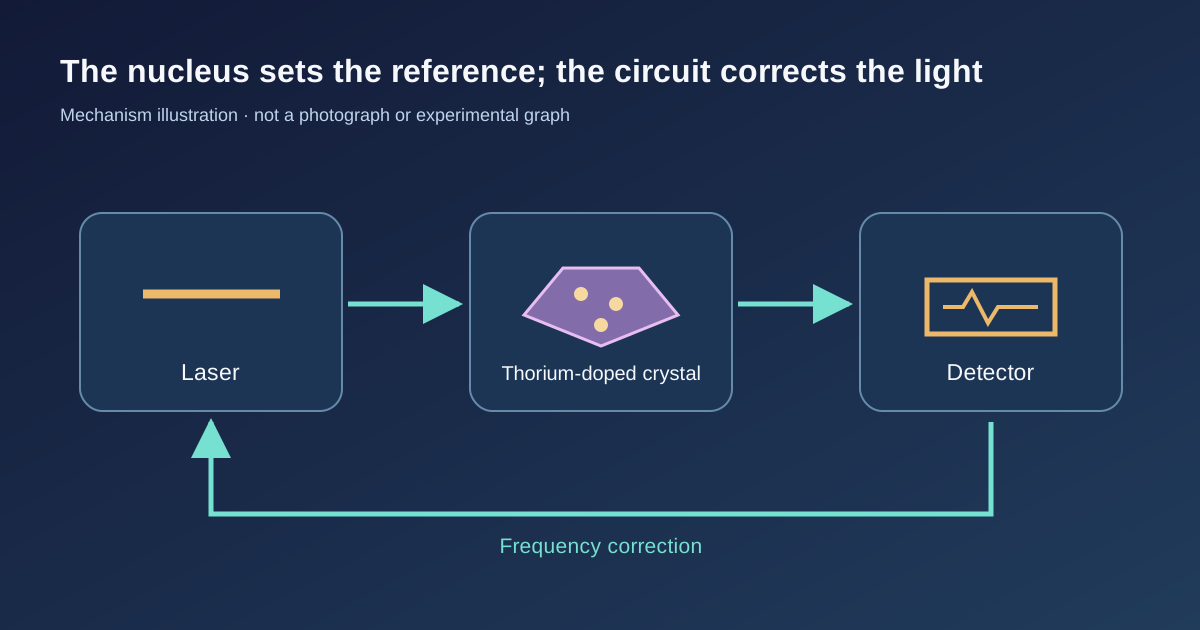
Luca Toscani De Col, Thomas Riebner, Ira Morawetz and colleagues embedded thorium-229 in a millimeter-scale calcium fluoride crystal at room temperature. When the laser's frequency matches the frequency the nuclei absorb, it reaches resonance. The team measured that absorption, detected when the laser moved away from the match, and fed the information back to adjust it. Feedback means repeating this measurement and correction instead of making a single adjustment.
In simple terms: imagine tuning an instrument to a reference note. The laser is the note that can slip; the nuclei provide the reference; the absorption measurement tells the system which way to correct. The apparatus does not read seconds directly from a nucleus. It keeps light aligned with the nuclear frequency and uses the light's oscillations as the basis for timekeeping.
In their paper in Nature, the researchers compared the stabilized frequency with a clock based on a ytterbium ion—an electrically charged ytterbium atom serving as another reference. Fractional instability describes how much a frequency varies over a given measurement interval. Here it fell approximately as 3 × 10⁻¹² divided by the square root of the observation time in seconds, approaching 10⁻¹⁵ after a day. That is a measure of stability over the observed interval, not proof of absolute accuracy over millions of years.
TU Wien's institutional account of the same apparatus, which names no individual reporter, points to fundamental-physics tests as a possible use. The researchers also searched for frequency oscillations predicted by certain models of ultralight dark matter—a hypothetical form of matter that has not been identified—over periods from 20 seconds to one day. Their analysis constrained the models examined; it did not detect dark matter. Other recently reported nuclear clocks are separate experiments and are not part of this result.
What the evidence establishes is a system in which a nuclear reference continuously steers laser light for more than a day. It does not establish a precision record or a ready-made tool for navigation or communications. Lower noise and longer comparisons will show whether this architecture can compete with the strongest atomic references and extend tests of physical laws.
Key points
- Absorption by thorium nuclei steered a laser continuously for more than 24 hours.
- Its fractional instability approached 10⁻¹⁵ after one day of averaging; that is stability, not absolute accuracy.
- The experiment constrained certain dark-matter models without detecting dark matter.
Comments
No comments have been published yet.
Sign in with a subscription to comment.