
Radio Emissions From β Pictoris b Point to an Extreme Magnetic Field
MeerKAT pinpointed radio bursts at the planet. If they are produced by the auroral mechanism proposed in the study, the emitting region has a magnetic field of at least 1,250 gauss. The manuscript has not yet undergone peer review.
Leitura autorizada · 3 crédito(s) restante(s)
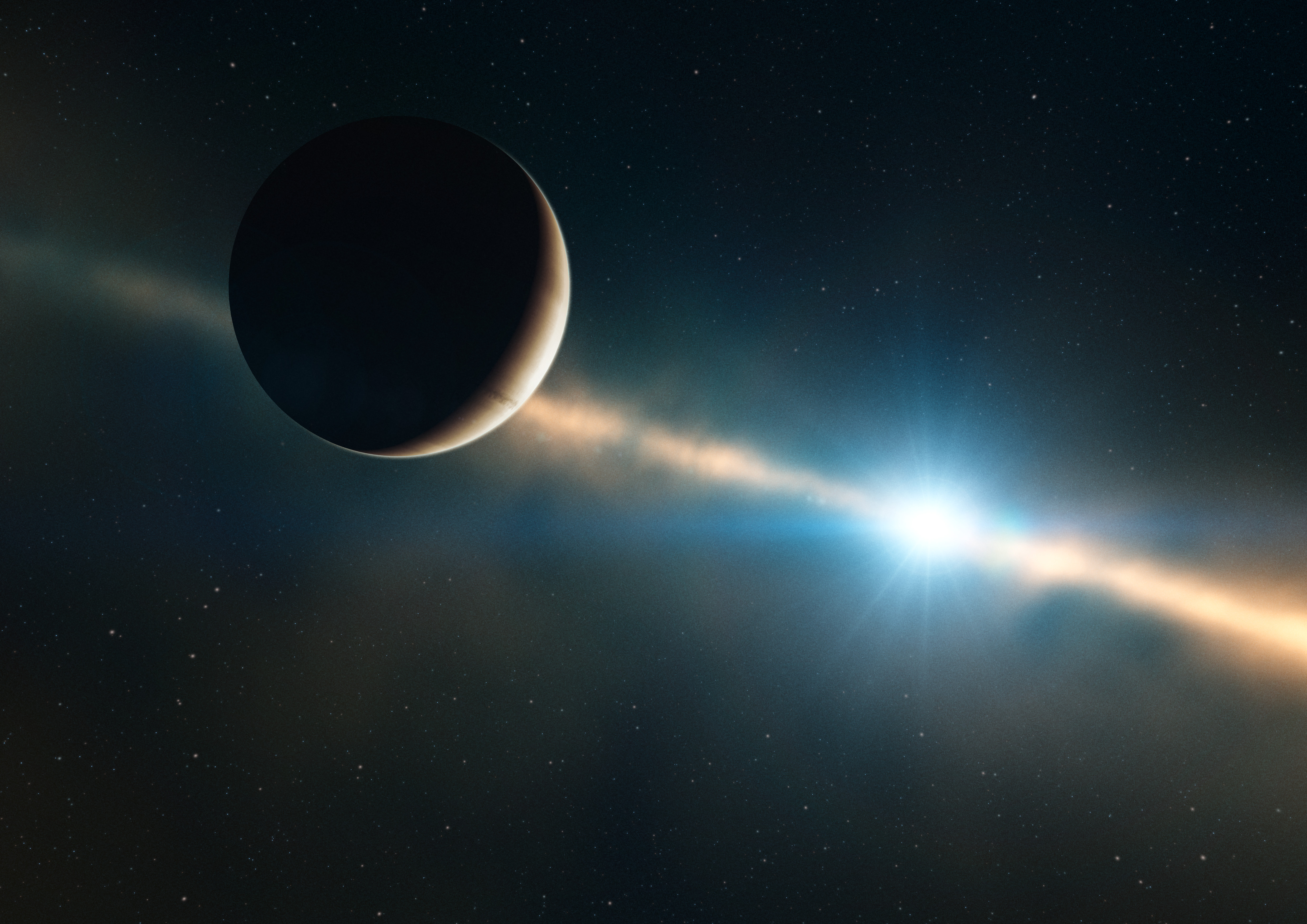
Radio bursts traced to β Pictoris b provide the most direct evidence yet of a magnetic field on a planet outside the Solar System. MeerKAT measured the waves’ position, frequency, variability and polarization. The field strength comes from the next step: if the signal is generated by the auroral mechanism indicated by those properties, its maximum frequency requires at least 1,250 gauss at the emission site. The result was presented on September 15 as a preprint, a scientific manuscript that has not yet been peer-reviewed.
β Pictoris b is a young, hot gas giant with about 12 times Jupiter’s mass, located approximately 64 light-years away. It orbits the star β Pictoris at nearly 10 times the distance between Earth and the Sun and rotates on its axis every eight or nine hours. Its scientific value lies in the access it offers to planetary magnetism and the planet’s interaction with the surrounding plasma, not in Earth-like surface conditions.
Kevin Ortiz Ceballos and Edo Berger of the Center for Astrophysics | Harvard & Smithsonian, and Yvette Cendes of the University of Oregon, examined the system with MeerKAT, an array of 64 radio antennas in South Africa. In four observing sessions conducted between 2025 and 2026, the observatory recorded continuous emission and rapid bursts between 0.85 and 3.5 gigahertz. One gigahertz equals one billion wave oscillations per second.
The position resolved an ambiguity that had constrained earlier searches. The researchers used distant celestial sources whose positions are known with great precision to determine where the emission originated. This technique, known as astrometry, placed the radio source in the vicinity of β Pictoris b. Within the statistical model used, the signal was inconsistent with the star’s position at 4.4 sigma; β Pictoris c, another planet in the system, was ruled out as the source at 4.8 sigma.
The bursts showed approximately 40% to 70% circular polarization: the orientation of the wave’s electric field rotated in an orderly way as the wave traveled. Their frequency, polarization and rapid variability match the expected pattern of electron cyclotron maser instability, or ECMI, emission. In this process, electrons accelerated around magnetic-field lines generate intense, highly organized radio waves. The same mechanism accompanies auroras on planets in the Solar System.
If that identification is correct, the frequency becomes a gauge of magnetism. The highest frequency the mechanism can produce increases with the field strength at the point of origin. The observed upper limit of 3.5 gigahertz corresponds to at least 1.25 kilogauss, or 1,250 gauss, in that emitting region. For scale, the magnetic field near Earth’s surface is on the order of half a gauss. The difference of several thousand times is not a comparison between equivalent global averages: it places a local lower limit on β Pictoris b alongside a surface measurement on Earth.
A planetary magnetic field organizes the magnetosphere, the region in which magnetism controls the motion of electrically charged particles. It deflects plasma but can also channel it, changes where particles strike the atmosphere and shapes the routes through which gases escape. Magnetic protection therefore does not automatically mean less atmospheric loss or lower radiation at the surface. For β Pictoris b, the measurement primarily informs researchers about its interaction with the space environment and its dynamo, the set of motions in electrically conducting material inside the planet that sustains the field.
What was measured: a radio source consistent with the position of β Pictoris b; frequencies between 0.85 and 3.5 gigahertz; circular polarization of 40% to 70%; and recurring bursts. What was inferred: auroral emission through electron cyclotron maser instability; a minimum local field of 1.25 kilogauss; and possible modulation by the planet’s rotation. The plasma reservoir feeding the process remains unknown.
Science News physics reporter Emily Conover spoke with astronomer Joe Callingham of the University of Amsterdam, who was not involved in the work. He considers the evidence compelling, but says the decisive test will be to track the bursts long enough to demonstrate a regular eight- to nine-hour pulse. Repetition synchronized with the planet’s rotation would turn the auroral interpretation into a more robust tool for studying the magnetospheres and interiors of other worlds.
Key points
- MeerKAT pinpointed persistent emission and strongly polarized radio bursts at β Pictoris b.
- Under the proposed auroral interpretation, 3.5 GHz implies a minimum local magnetic field of 1,250 gauss.
- Rotation-linked periodicity and peer review are still needed to confirm the new method.
Comments
No comments have been published yet.
Sign in with a subscription to comment.