
PACMAN brings multiple AI controls into the DIII-D tokamak
Across five experimental applications, the architecture read diagnostics, ran models and screened commands in milliseconds; in one, it anticipated an instability by about 200 ms.
Leitura autorizada · 3 crédito(s) restante(s)
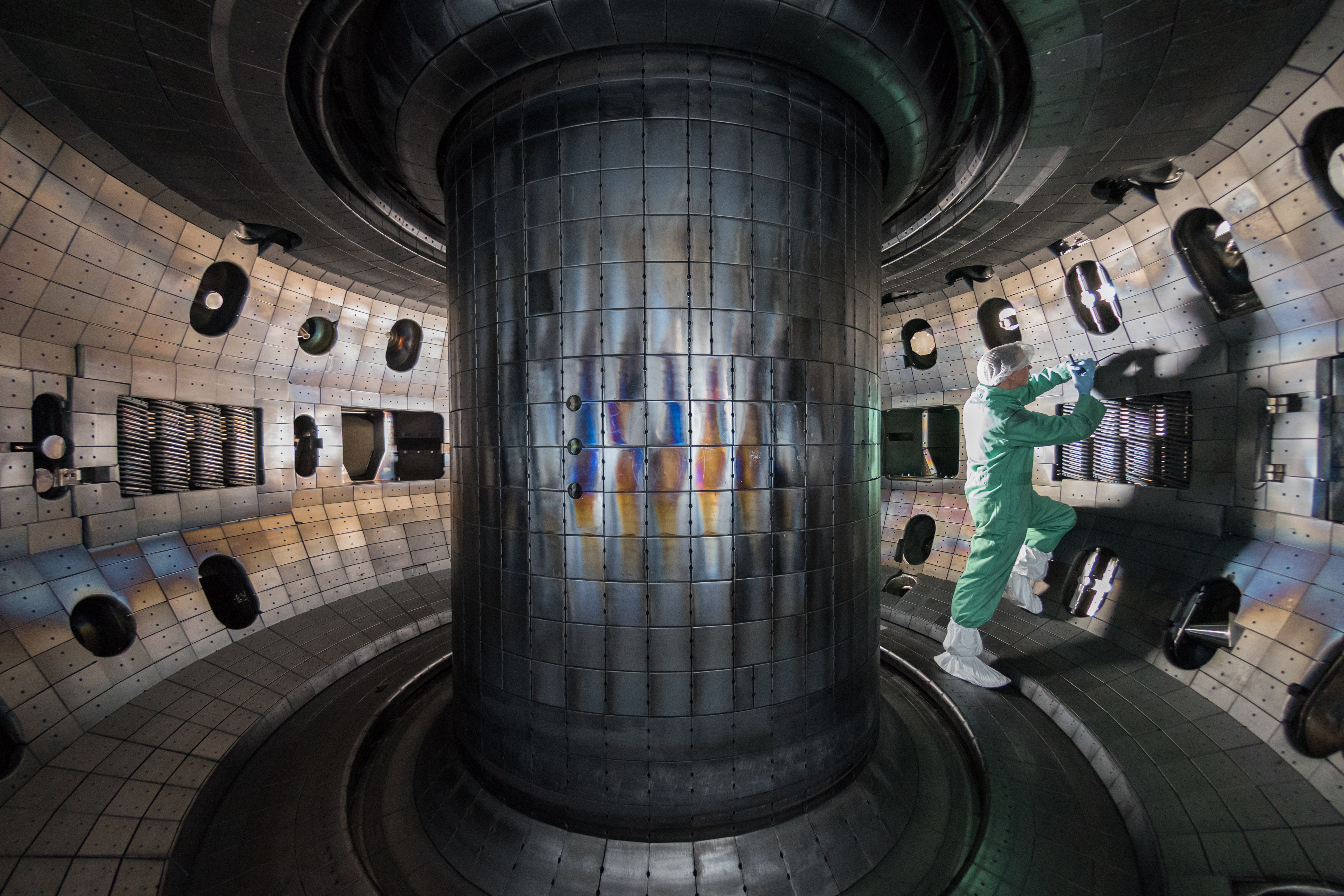
Confining plasma in a tokamak requires corrections to changes that can grow within milliseconds. Machine-learning models could already predict or control specific tasks, but each demonstration usually reached the machine as a stand-alone system. Andrew Rothstein, Hiro Farre-Kaga, Egemen Kolemen and their colleagues asked whether several models could use the same diagnostics and actuators without issuing incompatible commands. Their answer was an architecture called PACMAN, short for Prediction And Control using MAchiNe learning, installed on the DIII-D research tokamak in the United States.
PACMAN organizes control into four stages. It first gathers real-time measurements, including temperature, density and magnetic signals, and checks them for errors. Models selected for each task then estimate the plasma's state or immediate evolution. Controllers turn those estimates into requests for heating, gas injection and other actuators. A final layer resolves competing requests, applies the machine's physical limits and only then sends commands. A typical full cycle takes about 20 milliseconds and repeats throughout an experimental shot.
The paper describes five separate applications on DIII-D. A reinforcement-learning controller managed heating systems; one model estimated the probability of energy bursts at the plasma edge; another detected and controlled waves driven by fast particles; a controller steered density and rotation profiles toward targets set by researchers; and a fifth sought to predict and avoid a tearing mode. A tearing mode is a magnetic instability that reorganizes the plasma and can reduce performance. The five tasks used the same input, decision and output structure, but they were not a single simultaneous test of every capability.
In the tearing-mode demonstration, the model calculated the probability that the instability would emerge within a configurable time window. Once that probability crossed a threshold, the controller redirected microwave heating to an appropriate region of the plasma. According to the laboratory, the prediction arrived about 200 milliseconds before the instability was expected to appear, whereas conventional controls usually detect it after onset. That lead time allowed the plasma to be changed to avoid the event instead of trying to suppress it once underway.
The architecture also coordinated six gyrotrons, microwave sources that heat the plasma, by adjusting power and mirror positions to meet predefined goals. Human operators remained responsible for choosing those goals and setting parameters between shots. If an input failed, the associated controller did not issue a new request; the final layer also constrained every command to safe hardware ranges. The demonstrated autonomy therefore concerns rapid execution, not the choice of scientific objectives or the decision to operate the tokamak.
The central advance is control engineering: a common infrastructure accepted different models, settled actuator conflicts and operated in real experiments. That could reduce the work needed to bring new algorithms onto DIII-D. Whether the same arrangement remains fast, stable and safe on other tokamaks will require new installations and tests; the published experiments did not measure net energy production or the performance of a future fusion power plant.
Key points
- PACMAN links measurements, models, controllers and a final safety gate in a typical cycle of about 20 ms.
- Five distinct applications ran on DIII-D, including control of heating, plasma profiles and instabilities.
- In one test, the architecture anticipated a tearing mode by about 200 ms; transfer to other tokamaks remains unproven.
Comments
No comments have been published yet.
Sign in with a subscription to comment.