
Orbit points to a recent encounter between two massive protostars
The three-dimensional motion and tilted disks of IRAS 07299−1651 favor a scenario in which the two objects formed separately before becoming a pair.
Leitura autorizada · 3 crédito(s) restante(s)
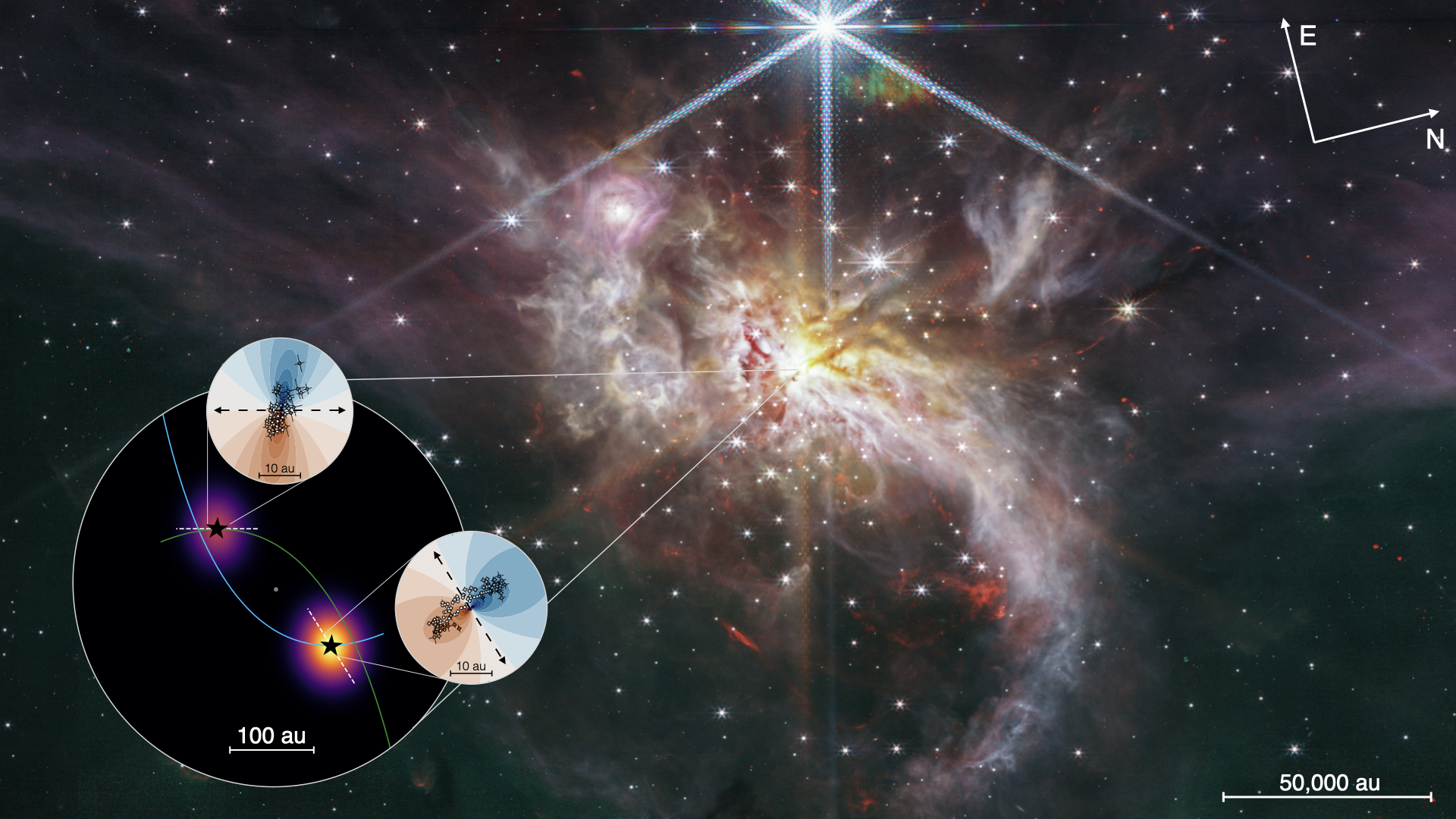
Massive stars often occur in pairs, but the beginnings of those systems are difficult to observe. Two stars might arise when the same gas disk fragments, form in separate cores of a cloud and later meet, or be brought together by interactions in a cluster. Yao Wang, Yichen Zhang and their colleagues tried to distinguish among those routes in IRAS 07299−1651, a pair of protostars still embedded in the cloud that feeds them.
The researchers compared observations from the Atacama Large Millimeter/submillimeter Array (ALMA) and the Jansky Very Large Array spanning nearly eight years. Tiny changes in the protostars' relative positions revealed motion across the plane of the sky. Hydrogen recombination lines—emission produced when electrons rejoin hydrogen ions—provided velocities along the line of sight. Images from the James Webb Space Telescope and the Very Large Telescope showed the directions of the jets. Together, the measurements reconstructed the orbital motion in three dimensions and the orientations of the disks around each object.
The preferred orbital solutions describe a highly elongated, nearly parabolic path and a current separation of about 200 astronomical units; one astronomical unit is the average Earth–Sun distance. “Nearly parabolic” does not mean the stars draw a visible curve in the sky. It means the estimated orbital energy lies near the boundary between a gravitationally bound ellipse and an open passage in which the objects would separate forever. The current data therefore do not yet determine whether the pair will remain bound.
The disk geometry supplied another clue. Hydrogen lines and jet directions indicate that the two circumstellar disks rotate in planes strongly tilted relative to the orbit and to each other. Orderly fragmentation within one disk would tend to produce more similar orientations. The team interprets the combination of an eccentric orbit and misaligned disks as evidence that each protostar began forming in a different gas core. A near-parabolic encounter would then have brought the cores together and produced the present configuration. In representative orbital solutions, closest approach occurred roughly 60 years before the observations, but that date is a model estimate rather than a directly observed scene.
The study calls this route a “core merger”: the gas cores meet and begin assembling a binary system while the protostars and their disks remain identifiable. The phrase does not mean that the two stars physically merged. The result also revises the interpretation of observations published in 2019, which were then compatible with joint formation through fragmentation of a shared disk; the longer baseline revealed orbital motion and made the misalignment difficult to dismiss.
IRAS 07299−1651 therefore provides a concrete case in which an encounter between initially separate cores best explains the observed architecture. The system does not show how often this route builds massive pairs across the Galaxy. Years-long monitoring of other protostars can test whether very eccentric orbits and misaligned disks are an exception or a recurring stage in massive-binary formation.
Key points
- Nearly eight years of radio data enabled a three-dimensional reconstruction of IRAS 07299−1651's motion.
- The highly eccentric orbit and two misaligned disks favor separate formation followed by a close encounter.
- The scenario explains this system but does not yet establish how common the route is among massive binaries.
Comments
No comments have been published yet.
Sign in with a subscription to comment.