
An injection and special glasses helped blind participants locate objects
In an early trial of ten people, seven detected fainter light after treatment. The combined system enabled simple visual signals, still far from ordinary sight.
Leitura autorizada · 3 crédito(s) restante(s)
Finding a doorway may begin with something as basic as detecting a light signal against the dark. In an early trial involving ten people who had lost vision to advanced retinitis pigmentosa, an injection into the eye combined with special glasses increased light sensitivity in seven participants. Some also located objects and doors in tasks performed with the glasses. This is detection of simple visual signals in a small group, not a return to ordinary sight.
Retinitis pigmentosa is a group of inherited conditions in which the retina's light-receiving cells gradually deteriorate. The retina is the tissue at the back of the eye that starts the process of seeing. Even after those receptors are lost, some retinal ganglion cells, which send information from the eye toward the brain, can survive. José-Alain Sahel, Stefan Futterknecht, Isabelle Audo and colleagues tested whether these remaining cells could be made responsive to light.
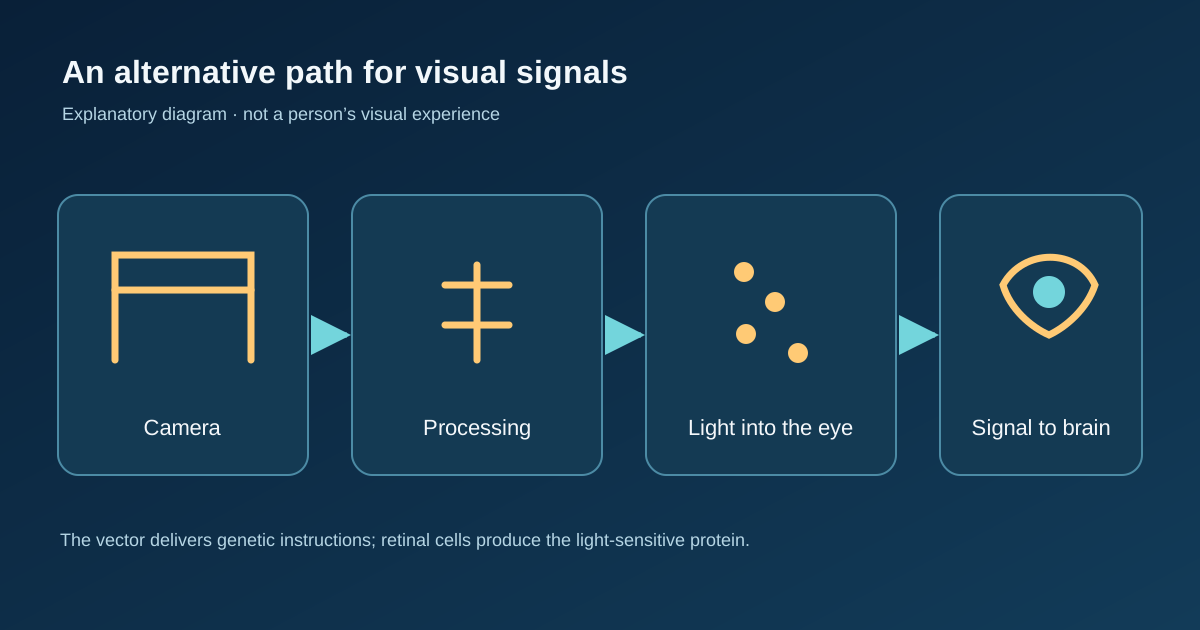
The team injected the worse-seeing eye of each participant with a viral vector—a carrier that delivers genetic instructions to cells. Those instructions cause the cells to make ChrimsonR, a protein activated by reddish light. This approach is called optogenetics: it equips cells with a light-responsive protein. A camera on the glasses captures the scene; the device turns it into light patterns and projects them into the treated eye. The intervention tested therefore includes the glasses and training as well as the injection.
In simple terms: the camera records what is ahead, the glasses convert that scene into suitable light, and modified retinal cells pass the signal onward. The system may help someone detect where an object is, but it does not deliver a sharp photograph to the brain. One measure was the light threshold—the faintest light detected while the other eye was covered. Tasks involving objects assessed a different ability.
In the study published in The New England Journal of Medicine, seven of ten participants detected fainter light, with sensitivity gains ranging from 2.0 to 62.3 times. Six exceeded a gain of 0.6 on a logarithmic scale, roughly fourfold sensitivity, a threshold considered clinically meaningful in the analysis. The threshold was grounded in earlier literature but had not been specified in advance in the trial protocol. The researchers also recorded signs of visual processing with electroencephalography, which measures the brain's electrical activity.
The PIONEER trial was open-label: participants and researchers knew the treatment being given, and there was no randomized comparison group. Its primary aim was safety. The paper's abstract reports 34 eye-related adverse events in nine people: 23 mild, ten moderate, and one severe but transient blockage of a retinal artery immediately after injection, which resolved within minutes. The Institute of Molecular and Clinical Ophthalmology Basel also described this study in a release with no named individual reporter; the design and numbers here follow the paper by Sahel and colleagues.
Together, the injection and glasses show that remaining retinal cells can relay useful visual information for some simple tasks after advanced loss of natural light receptors. The evidence does not establish reading, face recognition, normal vision, or effectiveness for other retinal diseases. Larger comparative studies must determine how durable the improvement is, what daily activities it supports, and how safely it can be achieved.
Key points
- Seven of ten participants detected fainter light; six crossed the threshold used in the analysis.
- The injection supplies genetic instructions to surviving retinal cells, which make a light-sensitive protein; the glasses supply light patterns.
- The small open-label trial primarily assessed safety and does not demonstrate normal vision.
Comments
No comments have been published yet.
Sign in with a subscription to comment.