
One molecule, many effects: from synapse to cognition
Neurotransmitters are not labels for pleasure, sadness, or memory. Their effects arise from receptors, cells, glia, timing, and the network in which signaling occurs.
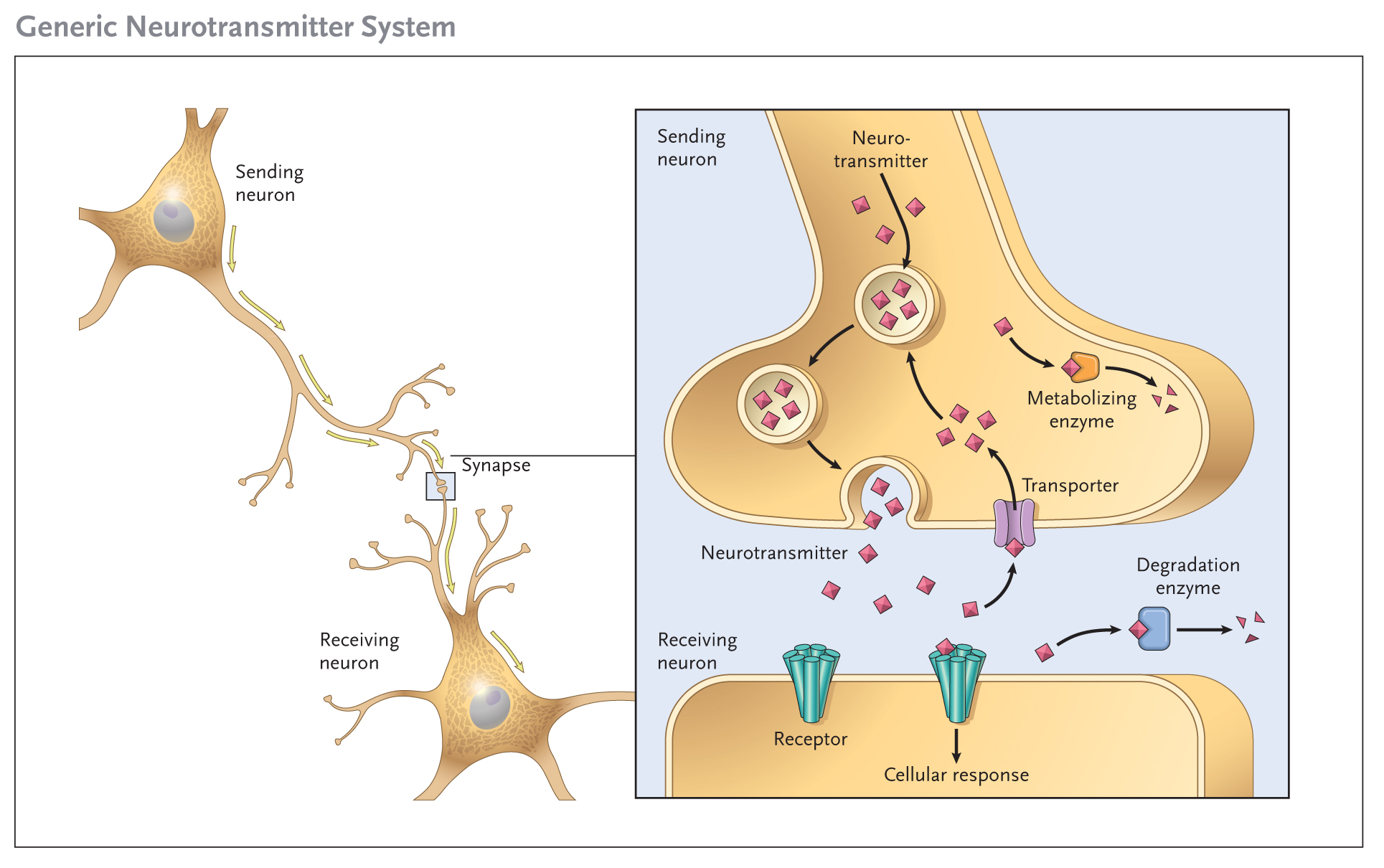
The question sounds simple: what do dopamine, serotonin, glutamate, or acetylcholine do in the brain? A sound answer begins by rejecting an attractive equivalence. A neurotransmitter does not carry a fixed psychological meaning by itself. The same molecule can excite, inhibit, or modulate a cell depending on receptor subtype, receptor location, membrane state, cell identity, and the active circuit. Chemistry supplies possibilities; system organization determines the outcome.
A first branching point lies at the receptor. Ionotropic receptors directly open channels and usually generate rapid responses, whereas metabotropic receptors activate G proteins and intracellular messenger cascades that are generally slower and longer lasting. This does not make one family an on switch and the other an off switch. The NCBI notes that transmitted information depends on both the neurotransmitter and the postsynaptic receptor; subunits, cellular position, and associated proteins add further layers of selectivity.
Glutamate shows why context matters. AMPA receptors support much of fast excitatory transmission; NMDA receptors combine ligand binding, voltage, and coagonist availability, allowing calcium entry under particular conditions. Calcium can recruit CaMKII and favor AMPA-receptor trafficking, one route studied in long-term potentiation. Yet LTP is neither a permanent recording nor the sole explanation of memory: there are multiple forms of plasticity, synaptic depression, excitability changes, protein synthesis, and circuit reorganization.
Monoamines also escape their popular nicknames. Dopamine is not simply pleasure, serotonin is not simply mood, and norepinephrine is not simply alertness. In mice, Cardozo Pinto and colleagues reported in 2026 that serotonin and dopamine oppositely modulate D2-receptor-expressing striatal neurons and that specific serotonin receptors participate in the effect. This is not a universal law of human behavior; it demonstrates the more useful principle that function depends on receptor subtype, cell population, brain region, and experimental task.
Nor is the synapse exclusively a conversation between two neurons. Astrocytes clear transmitters, regulate ions, provide metabolic support, and interact with many synapses. A 2025 Science study showed in an experimental model that norepinephrine could reshape synaptic efficacy through astrocytic adrenergic receptors and purinergic signaling. Recent reviews emphasize the regional diversity of these cells. The phrase tripartite synapse is therefore useful, provided it does not imply that every form of gliotransmission is settled or operates identically in every circuit.
Endocannabinoids add an unusual direction to information flow. Molecules such as 2-AG and anandamide can be produced on demand by a postsynaptic cell and travel backward to presynaptic CB1 receptors, reducing transmitter release. Medicines and psychoactive drugs exploit different points in this architecture by blocking transporters, inhibiting enzymes, occupying binding sites, or modulating receptors allosterically. The final effect never follows from the substance name alone; dose, affinity, distribution, timing, organism state, and interactions with other systems all matter.
How does this microscale reach cognition? Local changes alter firing probability and connection strength; repeated patterns select pathways across distributed networks; highly connected regions help integrate information across modalities. Neural-reuse models propose that action and perception circuits also contribute to concepts and language. Pulvermüller's review presents evidence and disputes around this view. It does not justify saying that a receptor processes syntax or a molecule creates an idea: language emerges from coordinated network dynamics shaped by learning, the body, and the social environment.
The best picture of the brain is therefore not a dashboard in which each chemical lights up one emotion. It is a multilevel system: ligands meet receptors; receptors transform signals; neurons and glia regulate the local environment; plasticity changes connections; networks integrate history and context. Chemistry is indispensable, but it does not rule alone. Between a synaptic cleft and a thought lies a chain of mediations, and that chain is where neuroscience finds its most productive complexity.
This article is a scientific synthesis and does not provide diagnosis or guidance on medicines or psychoactive substances. Findings from cells, tissue slices, or animal models clarify mechanisms, but they cannot be transferred automatically to subjective experience, human disease, or clinical decisions.
Key points
- A neurotransmitter's effect depends on receptor, cell type, location, timing, and circuit—not on the molecule alone.
- Astrocytes, synaptic plasticity, and interactions among neuromodulators defeat simple equations such as dopamine equals pleasure.
- Cognition and language emerge from distributed networks; molecular mechanisms participate but do not encode thoughts or meanings by themselves.