
Quantum light and relativity verify a device’s position
Stations about 2 km apart combined laser pulses with timed replies to verify a position within a 74.3-metre region under the conditions of the experiment.
Leitura autorizada · 3 crédito(s) restante(s)
Two stations about 2 kilometres apart send signals to a device between them. It must measure the incoming light and reply quickly. With this arrangement, researchers in China verified the device’s position within a 74.3-metre region. The test combines quantum physics, which limits the copying of information, with relativity, according to which no signal can exceed the speed of light in a vacuum.
The study by Guan-Jie Fan-Yuan, Yang-Guang Shan, Cong Zhang and colleagues was published on 3 September 2026 in Nature Physics. The team includes researchers from the University of Science and Technology of China and Guangdong University of Technology. The question is concrete: how can we confirm that a device is where it claims to be, even when someone tries to answer on its behalf from somewhere else?
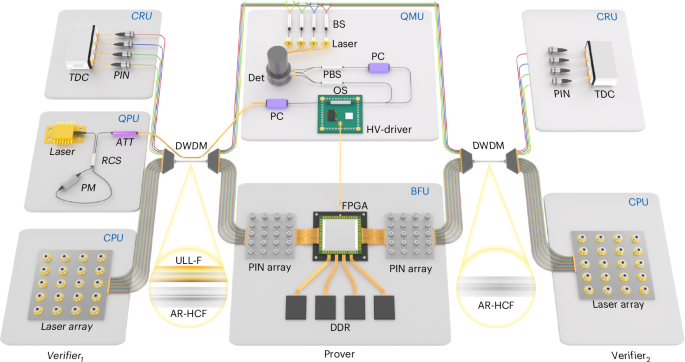
In the experiment, the device sits approximately 980 metres from each station. In every round, each station sends 20 bits, units of information that can take the value zero or one. One station also sends a very weak laser pulse whose polarization—the orientation of the light’s oscillation—carries the quantum information.
The device combines the two ordinary messages into a 40-bit input. A rule agreed in advance converts that input into a choice of how to measure the polarization. This choice is the measurement basis: the analyzer setting that allows the light signal to be interpreted correctly. After the measurement, the result is immediately returned to both stations.
The stations check both the answer and its arrival time. The answer indicates whether the light was measured as expected; the timing restricts the places it could have come from. A longer delay allows a wider region of possible positions because the signals have more time to travel.
Ordinary messages can be copied and relayed by accomplices, allowing checks based solely on this kind of information to be fooled when there are no additional safeguards. Quantum information changes the problem: no operation can perfectly copy every arbitrary unknown quantum state. Measuring the light without knowing the correct basis can also compromise the answer. The impostor’s challenge is to produce acceptable replies without missing the deadline.
One practical advance was to use attenuated laser light, meaning light of greatly reduced intensity, rather than require an ideal source that always emits a single photon, the unit of light energy. These pulses can contain no photons, one or several. The researchers incorporated that distribution into their security analysis and assumed the worst case for pulses containing several photons, which can assist interception.
Verification also counts incorrect replies and rounds with no reply, which can occur, for example, when light is lost. Each type of event receives a weight in the calculation of a score. The device is accepted only if its score exceeds the bound calculated for an adversary under the model’s conditions. The test therefore requires a collection of results consistent with the expected operation, rather than a single correct answer.
To reduce delays, the team sent the bits simultaneously at different wavelengths—the distances between repeating oscillations of the light wave—used as separate channels. They also used hollow-core optical fibres: structures that guide light mainly through air, bringing its propagation speed closer to that in a vacuum. In the central device, a circuit consults a table already loaded into memory to select the measurement, avoiding the need to calculate the whole rule while replying.
The researchers performed five trials, each containing 10 million rounds. All five, with the device following the intended procedure, exceeded the required score threshold. The system ran at 2 million rounds per second, so each trial gathered its data in a few seconds. This repetition provides statistical evidence about the apparatus’s operation; it does not amount to five replications by independent teams.
The largest additional delay was 247.8 nanoseconds—a nanosecond is one billionth of a second. This is the excess time relative to the signals’ ideal journey at the speed of light, not the total round-trip time. That excess corresponds to the 74.3-metre verification region: the extent of positions still compatible with the measured timings, rather than an exact location within it.
The result demonstrates that a device’s presence can be subjected to a physical test combining quantum measurement and propagation time. This opens a possibility for systems that authorize an operation only when the device is inside a permitted area. The experiment establishes the feasibility of such verification under the conditions studied; its performance and security beyond this setup still need to be demonstrated.
Key points
- Two stations verified a device’s position by combining its response to quantum light with the reply’s arrival time.
- Five trials of 10 million rounds passed the test; the additional delay bounded a 74.3-metre region.
- Security holds under the model’s assumptions, and use beyond the experimental setup still requires demonstration.
Comments
No comments have been published yet.
Sign in with a subscription to comment.