
A game tests quantum behavior with up to 55 qubits
An experiment with trapped ions exceeded the classical limit for a task with restricted information. The measured advantage is not a comparison of computing speed.
Leitura autorizada · 3 crédito(s) restante(s)
How can researchers verify that a processor is using quantum properties in a way that a classical strategy cannot reproduce? A study published September 5 in Nature Communications proposes a test built around a game. Marcello Benedetti and Harry Buhrman's team at Quantinuum devised rules with a mathematically provable classical limit, then compared that limit with results from a real processor.
The game starts with strings of zeros and ones, all of equal length. A referee divides the possible strings into two equally sized groups and keeps the division secret. The player receives a single copy of a quantum state prepared from the first group and must return a string belonging to the second. Under the classical strategy considered, the incoming state is measured immediately, revealing just one string from the first group. That information rules out the known string but leaves considerable uncertainty about the others: as the strings get longer, the best classical success rate approaches half of all attempts.
The quantum player can act before that measurement. The incoming state combines the possibilities in the first group in a superposition: they participate together in the system's physical evolution, although a final measurement reveals only one answer. A circuit rearranges the amplitudes—the quantities that determine measurement probabilities—to transfer the possibilities to the complementary group. In the ideal, error-free model, the answer then always belongs to the second group. The researchers chose divisions with a mathematical structure that makes both state preparation and answer verification efficient.
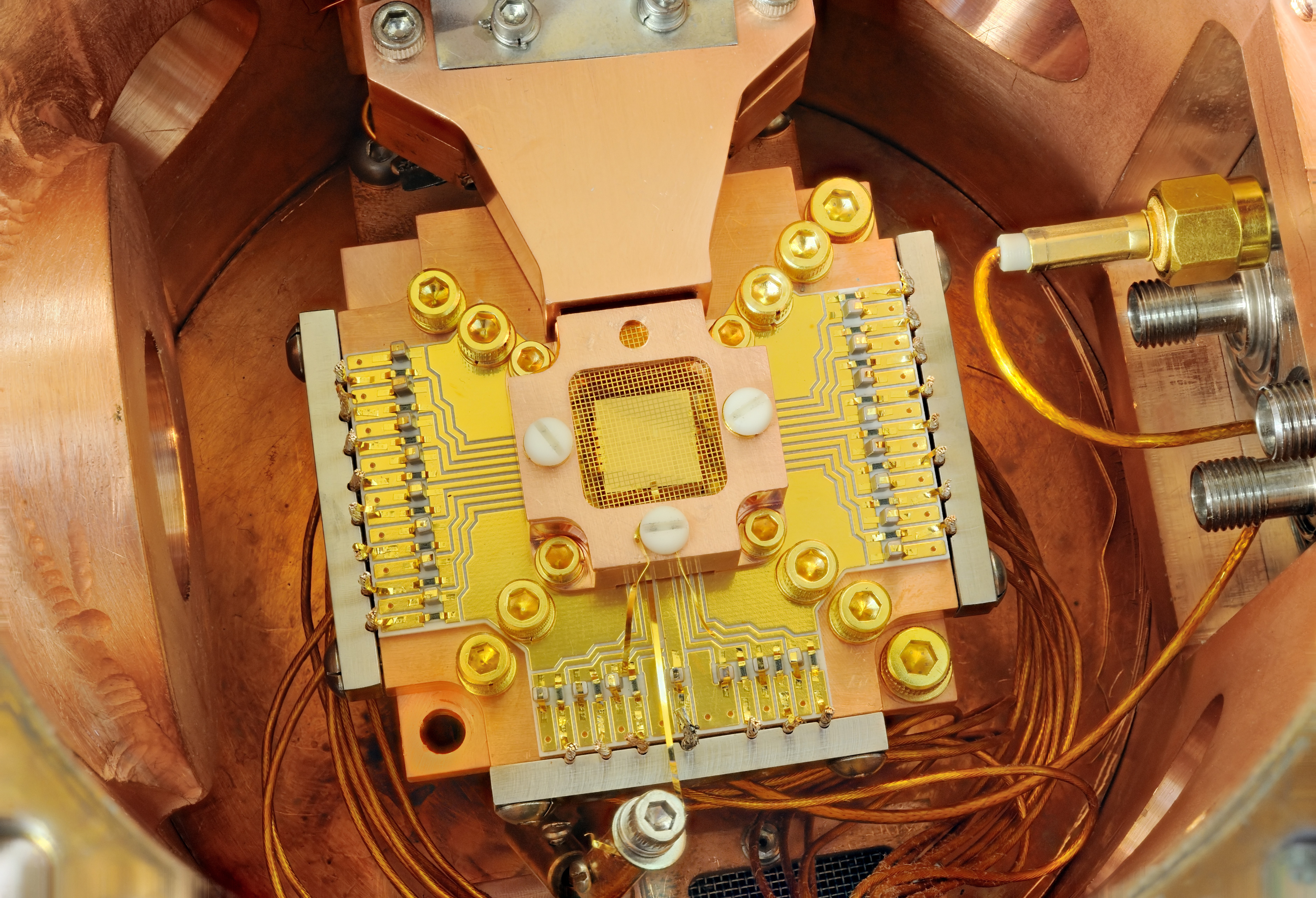
The team ran the protocol on H2, a processor that stores quantum information in trapped ions, using up to 55 qubits, the units of that information. The largest configuration used 37-bit strings. To assess the device, the researchers combined rounds of the game with rounds checking state preparation. The combined score fell in larger configurations, which suffered more errors, but remained above the classical limit in the reported tests.
The exponential growth highlighted in the paper refers to a ratio of adjusted scores: the quantum score's excess above a reference is compared with the largest classical excess above that same reference. It does not mean the success rate grew exponentially or that H2 ran a program exponentially faster. The contribution is a verifiable procedure for distinguishing the two kinds of behavior under explicit rules governing access to information.
The study thus demonstrates a way to test quantum processors against a proven classical limit, without relying on conjectures about the difficulty of solving particular problems. The proposed next step is to play the game between physically separate devices connected by a real quantum channel. In the reported experiment, the referee and player were implemented inside the same processor.
Key points
- The test compares strategies that receive a single copy of a state per round.
- H2 exceeded the classical limit in configurations using up to 55 qubits.
- The advantage concerns the game's score, not general computing speed.
Comments
No comments have been published yet.
Sign in with a subscription to comment.