A gravitational echo may constrain the first black-hole seeds
A new model links the nanohertz gravitational-wave background to very ancient seeds, but dark stars remain hypothetical.
OBSERVATION — The new work, published on August 17 in Physical Review D, does not report a detection of dark stars. It starts from the stochastic gravitational-wave background at nanohertz frequencies inferred by pulsar timing arrays and calculates how much different early populations of supermassive black-hole seeds could contribute to that signal across cosmic history. The authors modeled the evolution of host halos, black-hole growth and mergers, and the resulting spectrum.
MODEL RESULT — In the scenario examined, descendants of seeds formed by the collapse of supermassive dark stars, with a comoving density of order 10⁻³ per cubic megaparsec, can provide a major or dominant part of the measured background. The alternative direct-collapse channel considered was far rarer, near 10⁻⁶ per cubic megaparsec, and contributed less. Binaries totaling more than about one billion solar masses dominated the prediction at frequencies accessible to pulsar timing arrays.
INFERENCE — The background amplitude acts like a budget: if a model inserts too many massive seeds, their descendants overproduce waves; if it inserts too few, other routes must build the giant black holes that are observed. In the tested parameters, seed densities of roughly 10⁻² to 10⁻¹ per cubic megaparsec begin to exceed the observed signal, depending on dark-matter halo mass. A measurement made in the later Universe can therefore place statistical limits on populations proposed for redshifts above 10.
HYPOTHESIS — Dark stars are proposed, unobserved primordial objects whose main heat source would be dark-matter particle annihilation in the WIMP scenario rather than conventional nuclear fusion. Remaining relatively cool and extended, they could accrete gas and reach millions of solar masses before collapsing into heavy seeds. The study shows that descendants of such seeds are compatible with the nanohertz background at certain abundances; it does not establish that WIMPs, dark stars, or this lineage exist.
SPECULATION AND LIMITS — Connecting today's signal to cosmic dawn depends on prescriptions for halos, merger rates, accretion growth, and the joint evolution of galaxies and black holes. Other supermassive-binary populations and cosmological sources may contribute to the same background. Better pulsar-array spectra combined with censuses of distant black holes may distinguish among scenarios. Until then, this is a promising theoretical constraint: a quantitative bridge among gravitational waves, dark matter, and the origin of the first giants, not a picture of a dark star.
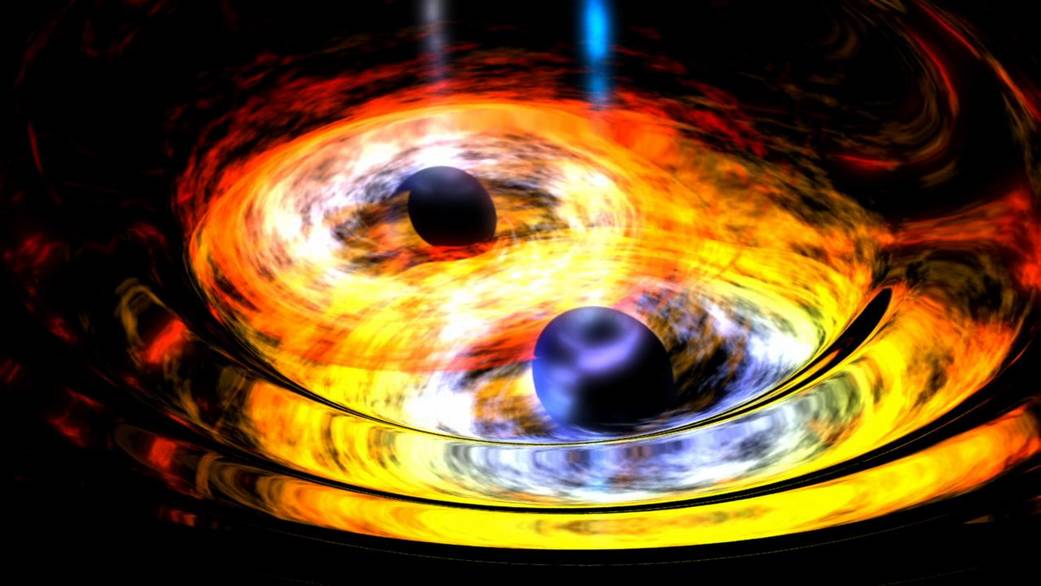
TRANSPARENCY — The account was checked against the primary paper, the Colgate University institutional release distributed by EurekAlert, and one additional current report. The image is a NASA artist's concept of a black-hole binary, used in an informational editorial context and credited under the agency's media guidelines; it illustrates the merger mechanism and is not an observation of the dark-star scenario.
Key points
- The study is a cosmological model built on the background already measured with pulsar timing.
- Dark-star seeds could dominate the signal only under specific abundances and assumptions.
- No dark star has been detected; the result constrains scenarios but does not confirm their existence.