
In assembloids, the thalamus changes the fate of cells that build the cortex
In human assembloids, thalamic axons contacted outer radial glia and favored upper-layer excitatory neurons; removing NRXN1 weakened both the contact and its effect.
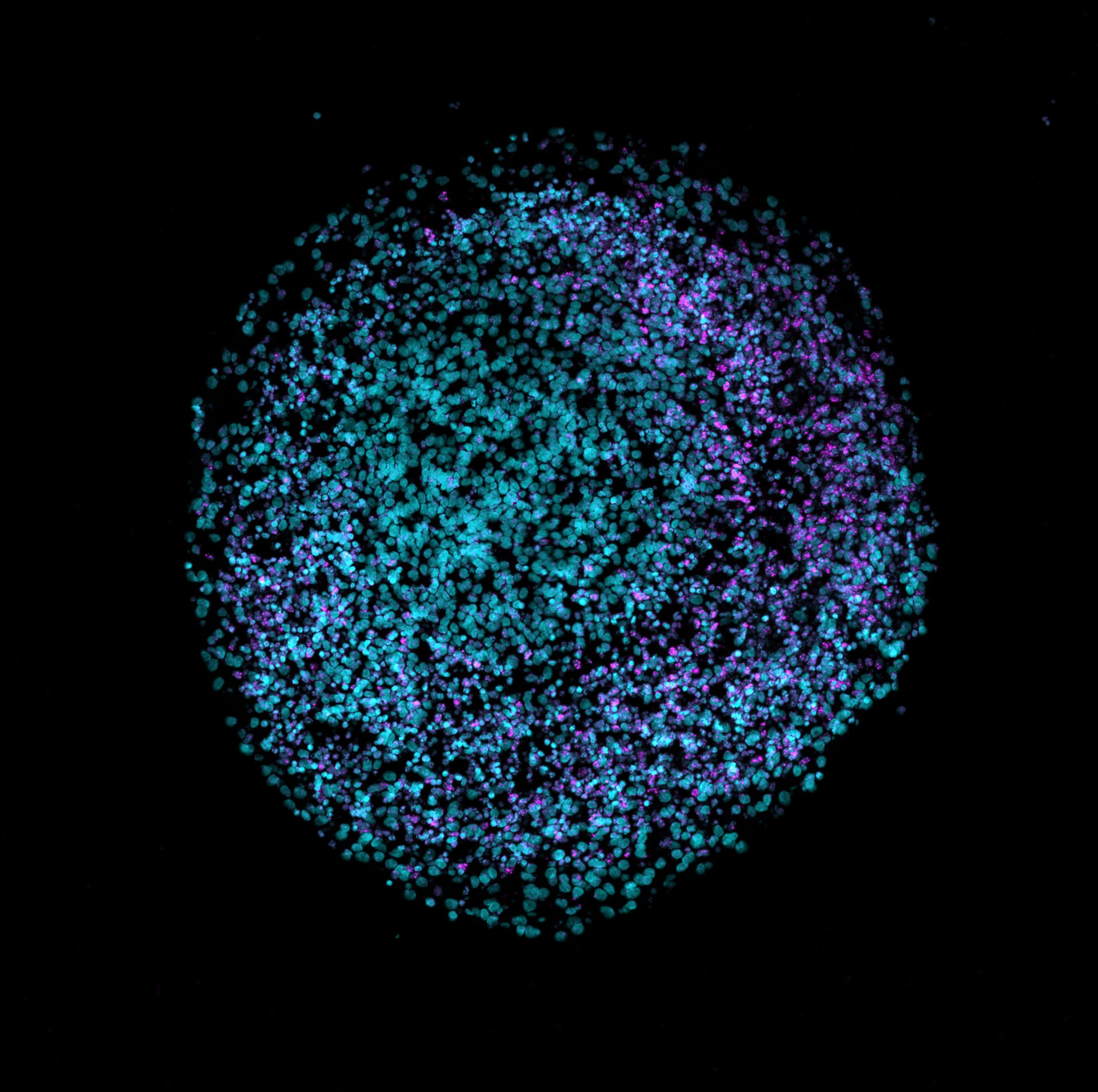
Before it relays sensations to the cortex, the thalamus appears to help choose which cells will build that region. A study published in Science on September 3 shows thalamic projections contacting human cortical stem cells and changing what they produce. In the experimental model, that contact favored excitatory neurons, particularly those of the cortex’s upper layers. The finding moves the thalamus’s role back from connecting neurons that already exist to an earlier stage, while the cellular repertoire is still being set.
Claudia Nguyen, Aparna Bhaduri and their colleagues separately grew human stem-cell-derived organoids representing the thalamus and cortex. About three weeks into development, they fused one organoid from each region, creating an assembloid in which thalamic axons could grow toward cortical tissue. Cellular imaging and single-nucleus RNA sequencing tracked the regions’ encounter and the identities of the cells produced. Cortex-only cultures, later separation of the two halves and genetic changes provided experimental comparisons.
Axons arriving from the thalamus did more than reach neurons. They directly touched outer radial glia, a progenitor population abundant in the primate cortex and associated with expansion of its upper layers. Assembloids receiving thalamic input produced more excitatory neurons than cortical controls, with an emphasis on upper-layer identities. The team also observed the interface in primary human cortical tissue, supporting the contact’s existence outside an organoid, although the causal manipulations were performed in the cultured system.
The mechanism converged on NRXN1, the gene encoding neurexin 1, a cell-adhesion protein best known for organizing neuronal connections. Disrupting NRXN1 in thalamic neurons reduced their contacts with outer radial glia and attenuated the production of upper-layer cortical neurons. The accessible public sources do not report the number of assembloids in each comparison, the numerical size of the neurogenesis increase or uncertainty intervals. They establish the effect’s direction but do not let us estimate its magnitude or variability here.
Removing thalamic input, breaking the contact and altering NRXN1 together support a causal relationship inside the assembloid: the axon acts as part of the environment guiding a progenitor’s decision. That does not mean the thalamus alone determines cortical architecture. Organoids do not reproduce the full circulation, cellular diversity or signaling history of a fetal brain, and the researchers regard it as likely—not conclusively demonstrated—that this particular contact is absent in rodents.
NRXN1 variants have previously been associated with neurodevelopmental conditions, including autism, but the experiment measured no symptoms and did not establish a single clinical pathway. It offers a narrower result: an early, observable and genetically tractable contact between an arriving brain region and a cell still choosing its fate. When that encounter occurs in human development, and how much it contributes to the cortex’s final composition, can now be posed as experimental questions rather than anatomical inference alone.
Key points
- Thalamic projections directly contacted human cortical progenitors before mature neural connections formed.
- Thalamic input favored upper-layer excitatory neurons; disrupting NRXN1 reduced contacts and attenuated that production.
- Causality was tested in assembloids and primary human tissue confirmed the interface, but public sources omit effect size, replication counts and uncertainty.
Comments
No comments have been published yet.
Sign in with a subscription to comment.