
Anak Krakatau’s eruptions change pace without ending the alert
A September 11 assessment records intermittent explosions after about 25 hours of continuous eruption; satellites show gases and ash spreading.
Leitura autorizada · 3 crédito(s) restante(s)
The end of a continuous eruption does not necessarily mean the end of a volcano’s activity. At Anak Krakatau, between Java and Sumatra, the question became how to interpret a change in the pace of explosions. Indonesian authorities’ assessment through 6 a.m. on September 11, 2026, Western Indonesian Time (UTC+7), kept the alert at level III, known as Siaga.
To track the change, Indonesia’s Geological Agency brought together visual observations and monitoring instrument records. The continuous eruption on September 4–6 lasted about 25 hours. After it ended, the agency counted 14 Strombolian eruptions through the assessment’s cutoff time. These are intermittent explosions associated with gas escaping from magma, capable of ejecting ash and incandescent fragments.
Seismic monitoring showed different signals near the surface and at depth. Some types of tremors associated with near-surface activity fluctuated with a downward trend, while volcanic earthquakes increased relative to the volcano’s average recorded pattern. The agency interprets the increase in deep events as a sign of magma movement or supply at depth. That interpretation helps explain why reduced surface activity did not lead to the alert being lifted.
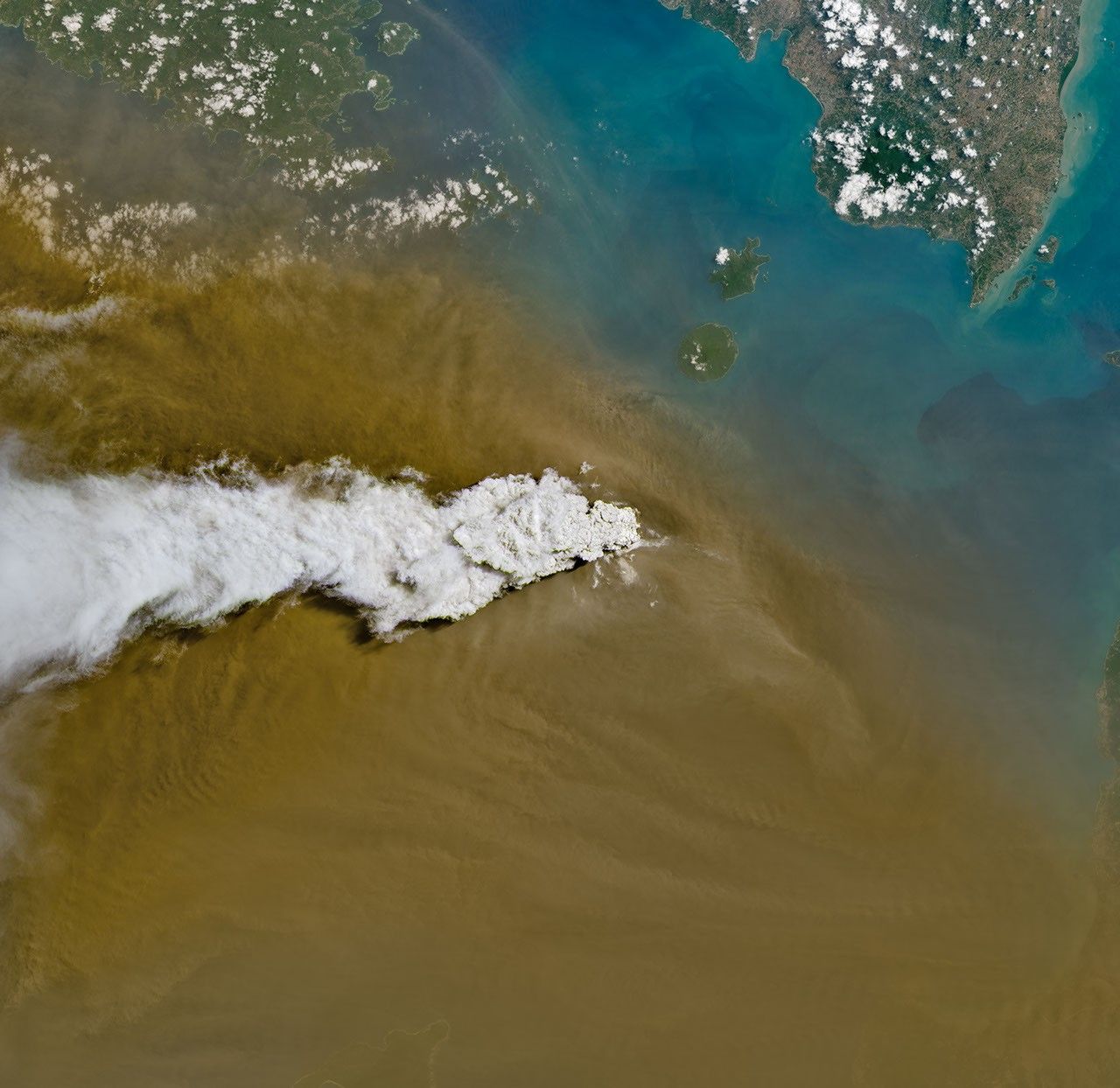
An orbital observation documented another part of the episode. In an image acquired on September 5 by the Landsat 8 satellite and released by NASA on September 9, a white plume of volcanic gases appears above an extensive brown ash cloud. Also on September 5, a sensor aboard the Suomi NPP satellite recorded dispersal over a wider area. The images show material that reached the atmosphere; they are not a picture of magma inside the volcano.
Indonesia’s meteorological agency, BMKG, analyzed the distribution of ash by satellite on September 6. The material spread in different directions depending on altitude and winds, affecting airspace. Assessing flight routes therefore requires tracking ash locations, not just the pace of explosions at the crater. NASA reported that air operations had resumed by September 8; that resumption did not mean the volcano had become inactive.
The records thus describe a change in eruptive behavior, not a demonstrated transition to inactivity. In the September 11 assessment, the official recommendation remained to stay outside a 3-kilometer radius of the active crater. For residents, mariners, and authorities, monitoring combines two problems: activity at the source and ash transport. Anak Krakatau’s subsequent behavior requires new observations; it cannot be inferred from a single photograph.
Key points
- The agency recorded 14 Strombolian explosions after the continuous phase, in its September 11 assessment.
- Deep seismic signals and reduced surface activity are not equivalent measures of the volcano’s condition.
- Level III and the 3-kilometer exclusion radius were maintained; ash dispersal requires its own monitoring.
Comments
No comments have been published yet.
Sign in with a subscription to comment.